Data Backup Solutions in Mumbai & Cloud Data Protection for Businesses
Every business depends on data in some form. Customer records, financial documents, emails, project files, databases, applications, and employee information all play a part in day-to-day operations. When that data becomes unavailable because of a hardware failure, ransomware attack, accidental deletion, or system issue, even a short period of downtime can affect productivity and customer service.
This is why dependable data backup solutions in Mumbai have become an essential part of business IT planning. A good backup strategy gives organizations secure copies of important information and a practical way to restore it when something goes wrong.
At the same time, more companies are moving applications and business information to cloud platforms. That makes cloud data protection for businesses equally important. The goal is not simply to store another copy of a file. It is to make sure important data remains protected, accessible, and recoverable when the business needs it most.
Why Businesses Need Reliable Data Backup
Data loss does not always happen because of a major cyberattack. In many cases, it starts with something much simpler: an employee deletes a folder, a hard drive fails, a server becomes corrupted, or a software update causes unexpected problems.
Businesses may also face :
- Ransomware and malware attacks
- Accidental file deletion
- Hardware or storage failures
- Human error
- Power interruptions
- Unauthorized access
- Cloud configuration mistakes
- Lost or stolen devices
- Software corruption
Professional data backup solutions in Mumbai help businesses prepare for these situations instead of reacting after the damage has already occurred.
A properly planned backup environment can protect employee devices, business servers, virtual machines, databases, shared folders, cloud applications, CRM systems, ERP platforms, Microsoft 365 data, and other operational information.
For organizations that rely heavily on online platforms, cloud data protection for businesses adds another layer of resilience by keeping recovery copies away from the primary environment.
Data Backup Solutions in Mumbai for Hybrid IT Environments
Most companies no longer store everything in one place.
A business may have local servers at its office, employee laptops used remotely, cloud-hosted applications, SaaS platforms, and virtual machines running critical systems. Because data is spread across different environments, backup needs to cover more than a traditional file server.
Modern data backup solutions in Mumbai should be able to support these different workloads through one structured data protection approach.
Endpoint Backup
Employee laptops and desktops often contain important documents that may not exist anywhere else.
Automated endpoint backup helps protect these files without depending on employees to manually copy them to another location. Backup policies can be applied centrally, making it easier for IT teams to manage devices across multiple users and offices.
Server Backup
Business servers may host shared folders, software applications, databases, and other critical systems.
With scheduled data backup solutions in Mumbai, companies can create regular recovery points and
restore data if a server experiences hardware failure, corruption, or accidental changes.
Database Backup
Databases often contain highly valuable business information such as customer details, transaction records, inventory data, and application information.
Database backups should be scheduled according to the importance of the workload and how much data the company can afford to lose.
Virtual Machine Backup
Virtual machines are commonly used to run business applications and internal systems.
Backing up the complete virtual machine can make recovery easier because administrators may be
able to restore files, applications, or the entire system depending on the incident.
What Is Cloud Data Protection for Businesses?
Cloud adoption has made it easier for employees to work from anywhere, share files, use SaaS applications, and collaborate in real time.
However, storing information in the cloud does not automatically mean that every version of that information is protected forever.
Cloud data protection for businesses refers to the tools and processes used to back up, secure, retain, monitor, and recover data stored in cloud platforms.
It can cover :
- Microsoft 365
- Exchange Online
- OneDrive
- SharePoint
- Microsoft Teams
- Cloud-hosted servers
- Virtual machines
- SaaS applications
- Cloud databases
- Shared cloud files
When setting up cloud data protection for businesses, companies should first identify which data is most important, how often it changes, how long backup copies should be retained, and how quickly information needs to be restored.
Why SaaS Data Still Needs a Backup
One common misunderstanding is that SaaS providers automatically protect users against every possible type of data loss.
Cloud providers usually maintain reliable infrastructure, but businesses can still lose access to information because of accidental deletion, compromised credentials, synchronization errors, malicious actions, or retention limitations.
For example, if someone deletes an important folder and that deletion synchronizes across connected devices, the business may need an independent backup copy to recover the earlier version.
This is where cloud data protection for businesses becomes valuable. It provides recovery options outside the live production environment and gives IT teams more control over how long data remains available.
Protecting Business Data Against Ransomware
Ransomware is particularly dangerous because attackers may not stop at encrypting business files. They may also attempt to compromise connected storage and backup repositories.
That is why simply keeping another copy on the same network may not be enough.
Advanced data backup solutions in Mumbai can include safeguards such as :
- Immutable backup storage
- Encrypted backup copies
- Offsite storage
- Restricted administrative access
- Multi-factor authentication
- Multiple restore points
- Backup isolation
- Monitoring and alerts
- Periodic restore testing
When these measures are supported by cloud data protection for businesses, organizations have a better chance of accessing clean recovery copies if the primary environment is compromised.
Backup should still be part of a broader cybersecurity strategy that includes endpoint protection,
access controls, security updates, employee awareness, and network monitoring.
Understanding the 3-2-1 Backup Approach
The 3-2-1 backup principle is a widely used approach to data protection.
It generally means maintaining three copies of important data, storing them using at least two different types of storage, and keeping one copy away from the primary location.
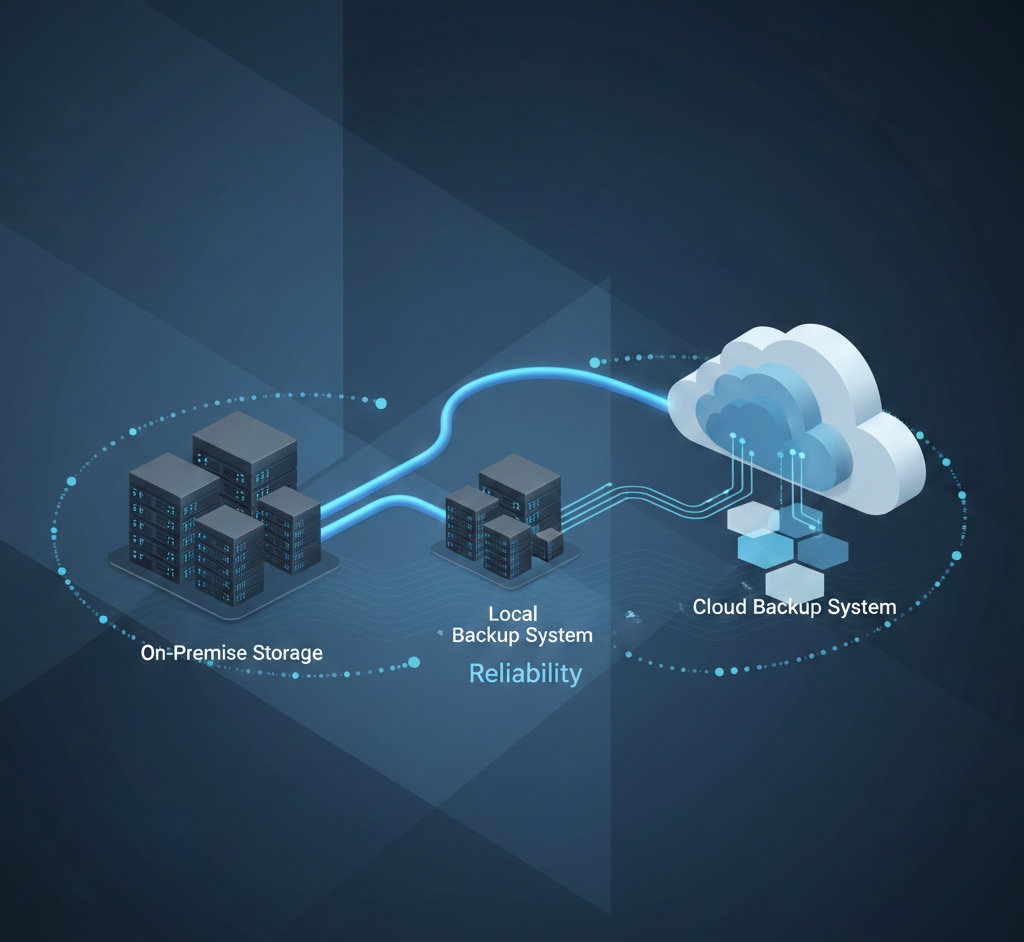
Businesses using data backup solutions in Mumbai may achieve this through a combination of production data, local backup storage, and an offsite cloud copy.
Adding cloud data protection for businesses can help reduce the risk of a single incident affecting
every available copy of business information.
Backup Security and Encryption
Backup data often contains the same confidential information as the original systems. It therefore needs the same level of attention when it comes to security.
Reliable data backup solutions in Mumbai should provide appropriate controls such as :
- Encryption while data is being transferred
- Encryption while backup data is stored
- Role-based access permissions
- Multi-factor authentication
- Secure credential management
- Activity logging
- Restricted administrator privileges
For cloud data protection for businesses, organizations should also understand where data is stored, who can access it, how restore permissions are managed, and what controls are available to prevent unauthorized deletion.
RPO and RTO: Two Important Backup Metrics
A backup strategy should be designed around the actual needs of the business.
Two commonly used terms are Recovery Point Objective and Recovery Time Objective.
Recovery Point Objective
Recovery Point Objective, or RPO, refers to how much recent data the business can afford to lose.
For example, if backups are created once every 24 hours, a failure could potentially result in several hours of lost work.
Businesses using data backup solutions in Mumbai should therefore set backup frequency according to the importance of each workload.
Recovery Time Objective
Recovery Time Objective, or RTO, refers to how quickly a system needs to be restored after disruption.
A critical business database may need to be available quickly, while archived files may not require immediate restoration.
The same principle applies when planning cloud data protection for businesses.
Why Backup Monitoring Matters
A backup system is only useful if backup jobs are actually completing successfully.
This sounds obvious, but failed or missed jobs can sometimes go unnoticed until an organization needs to restore data.
Modern data backup solutions in Mumbai can provide centralized monitoring and alerts for :
- Successful backups
- Failed backup jobs
- Missed schedules
- Storage usage
- Retention status
- Protected devices
- Available recovery points
- System warnings
Monitoring becomes even more important with cloud data protection for businesses, particularly when organizations manage multiple locations, users, servers, and cloud platforms.
Backup Testing and Recovery Validation
Having backup files does not automatically guarantee that recovery will work exactly as expected.
Regular restore testing helps organizations confirm that their backup strategy actually works in practice.
Businesses using data backup solutions in Mumbai should periodically test the recovery of important data such as:
- Individual documents
- User folders
- Emails
- Databases
- Servers
- Virtual machines
- Business applications
With cloud data protection for businesses, it is also useful to define who is authorized to request or perform a restoration and which systems should be recovered first during an incident.
Creating the Right Data Retention Policy
Not every backup needs to be stored permanently.
Retention policies define how long different recovery points remain available.
A business might keep daily backups for a short period, weekly backups for several months, and selected monthly or annual copies for longer-term requirements.
Flexible data backup solutions in Mumbai allow businesses to create different retention rules for different types of information.
Similarly, cloud data protection for businesses should take into account operational requirements, customer agreements, internal policies, and applicable regulatory obligations.
Data Backup and Disaster Recovery
Backup and disaster recovery are closely connected, but they serve different purposes.
Backup focuses on maintaining recoverable copies of data. Disaster recovery is broader and involves restoring applications, systems, infrastructure, and business operations after a serious disruption.
Strong data backup solutions in Mumbai provide the foundation for a practical disaster recovery plan.
A business recovery plan should identify :
- Critical applications
- Recovery priorities
- Maximum acceptable downtime
- Maximum acceptable data loss
- Backup storage locations
- Responsible team members
- Communication procedures
- Recovery processes
When local infrastructure is unavailable, cloud data protection for businesses can provide access to recovery copies stored outside the affected environment.
How to Choose Data Backup Solutions in Mumbai
Selecting a backup solution should involve more than comparing storage capacity and pricing.
When assessing data backup solutions in Mumbai, businesses should consider the following factors :
Coverage : The solution should support the systems your business actually uses, including servers, endpoints, databases, virtual machines, and cloud applications.
Security : Look for encryption, strong authentication, access controls, logging, and protection against unauthorized backup deletion.
Recovery options : Understand whether the solution can restore individual files, complete servers, databases, virtual machines, or applications.
Monitoring : Failed or missed backups should be easy to identify.
Scalability : The backup environment should be able to grow as the business generates more data.
Retention : Different systems may require different backup retention periods.
Support : Technical assistance can become particularly important during an actual recovery event.
Testing : Businesses should be able to verify that important backup copies can be restored
successfully.
Using well-managed data backup solutions in Mumbai together with reliable cloud data protection for businesses can help organizations build a more resilient IT environment without making backup management unnecessarily complicated.
Frequently Asked Questions
1. What are data backup solutions?
Data backup solutions create secure copies of important business information so that files or systems can be recovered after accidental deletion, ransomware, hardware failure, corruption, or other incidents.
2. Why do companies need data backup solutions in Mumbai?
Data backup solutions in Mumbai help businesses automate backups, maintain multiple recovery points, protect critical workloads, and reduce disruption when business information becomes unavailable.
3. What is cloud data protection for businesses?
Cloud data protection for businesses includes technologies and processes used to back up, secure, retain, monitor, and restore information stored in cloud environments.
4. Is cloud storage the same as cloud backup?
No. Cloud storage is mainly designed for storing, accessing, sharing, and synchronizing files. Backup is designed specifically to maintain recoverable copies of data in case the primary information is deleted, corrupted, or compromised.
5. How often should business data be backed up?
The right frequency depends on how much data the business can afford to lose. Critical systems may need frequent backups, while less important information may only require daily or weekly protection.
6. Can backup help after a ransomware attack?
Yes. Isolated, encrypted, or immutable backups can provide recovery options after ransomware. However, backup should work alongside endpoint security, access control, patching, and other cybersecurity measures.
7. Can Microsoft 365 data be backed up separately?
Yes. Many cloud data protection for businesses solutions can protect Microsoft 365 services such as Exchange Online, OneDrive, SharePoint, and Teams.
8. How long should backups be retained?
Retention depends on business requirements, internal policies, contractual obligations, and applicable regulations. Different types of data may need different retention periods.
9. What should businesses look for in a backup provider?
A business should evaluate security, recovery capabilities, monitoring, scalability, retention controls, technical support, workload compatibility, and restore testing before selecting data backup solutions in Mumbai.
10. Should businesses keep both local and cloud backups?
For many organizations, using both can provide additional resilience. Local backups may support faster recovery, while cloud data protection for businesses can provide an offsite recovery option if local infrastructure is unavailable.